Games
Why won't a word game accept my word? Four reasons
A word game won’t accept a real word when the word is missing from its list or breaks a rule of that particular puzzle. In Words Attraction’s English Daily Word, EMOJI is refused: its 8,625 accepted guesses come from a public-domain list compiled around 2000. In the Hive tutorial, RENTS is on the list and still refused, because the centre letter is A and every word must use it. Knowing which check caught you tells you whether the word is gone for good or only wrong for this puzzle.
Is the list of guesses the same as the list of answers?
No. Words Attraction keeps two lists for each language: a wide one for what you may guess, and a narrow one the answer is drawn from. Our reasoning for the split is simple. A game that refused uncommon guesses would feel unfair, and one that picked an uncommon answer would feel worse.
The guess list is permissive. In English it is every five-letter word in the dictionary the app ships, including many you will rarely say aloud. The answers come from a ranking of how often words appear in a large sample of English text, so the word of the day is a common one.
Some words are then pruned from the answers only: clinical, crude, derogatory and archaic ones. The archaic ANENT and the clinical ENEMA are both legal guesses in English Daily Word, and neither will ever be the answer. In Russian and Spanish, the rules for the answers also leave out the names of people and places, though a few Spanish names have still been the word of the day. Profanity and slurs are different: they are removed from every list, so the game refuses them as guesses too.
A refused guess in Words Attraction’s Daily Word costs you nothing. The row shakes, the tiles flash, the letters clear, and you still have every attempt you had. The game records a guess only after the list has accepted it.
Why are newer words missing from word games?
Because the list is older than the word. Words Attraction’s English dictionary is ENABLE2K, a public-domain word list compiled around 2000. It was chosen because it can ship inside the app as a plain list of word forms, and words that became common after it are not in it.
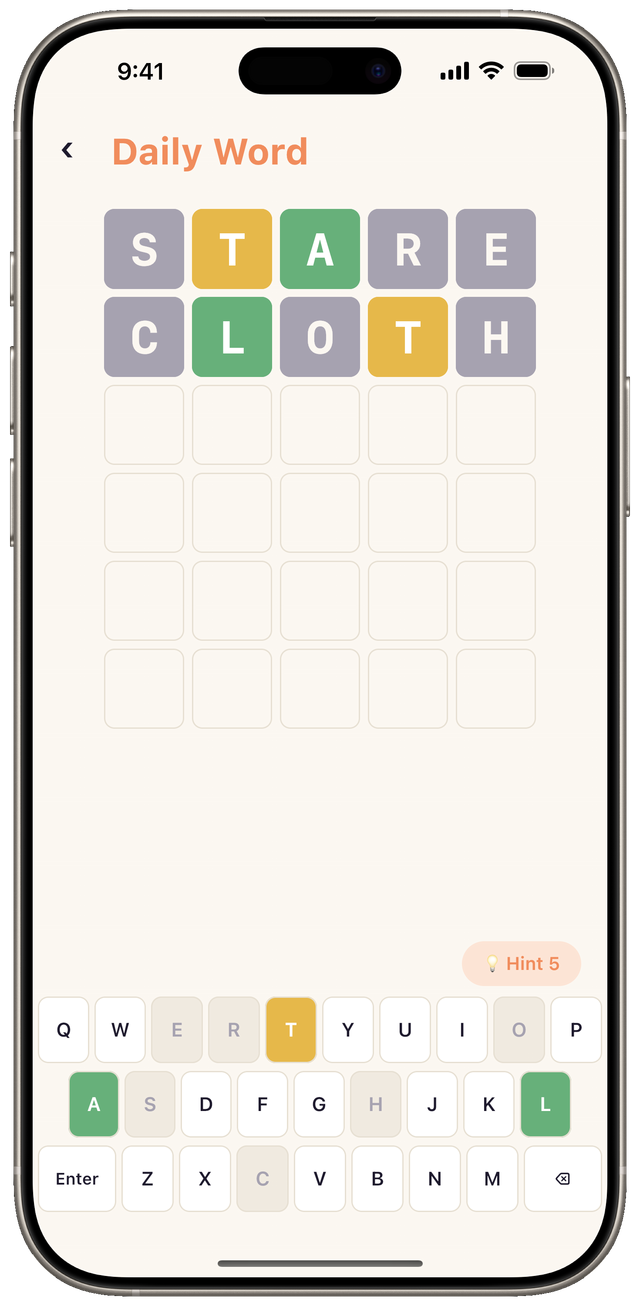
EMOJI is the example the app uses to teach this. The Daily Word tutorial has you type it, bounces it, and explains that “the list is a classic one, so a few newer words are missing.” BLOG, SELFIE and PODCAST are missing from the English list as well, so the app refuses all three wherever you try them.
The list also stops at ten letters. A real eleven-letter word gets “Not in word list.” in Hive or Chain Letters, however ordinary it is. No spelling fixes either gap, so try a different word.
Why does the game say my word breaks a rule?
Because in Hive and Chain Letters, the dictionary is one of the last things checked. Each game tests a word against its own rules in a fixed order, and it reports only the first rule the word breaks.
Hive checks, in this order:
- At least four letters — “Too short — at least 4 letters.”
- Only the seven letters on the pad — “Use only the seven letters above.”
- The centre letter somewhere in the word — “Must use the center letter.”
- On the list — “Not in word list.”
- Not found already — “Already found.”
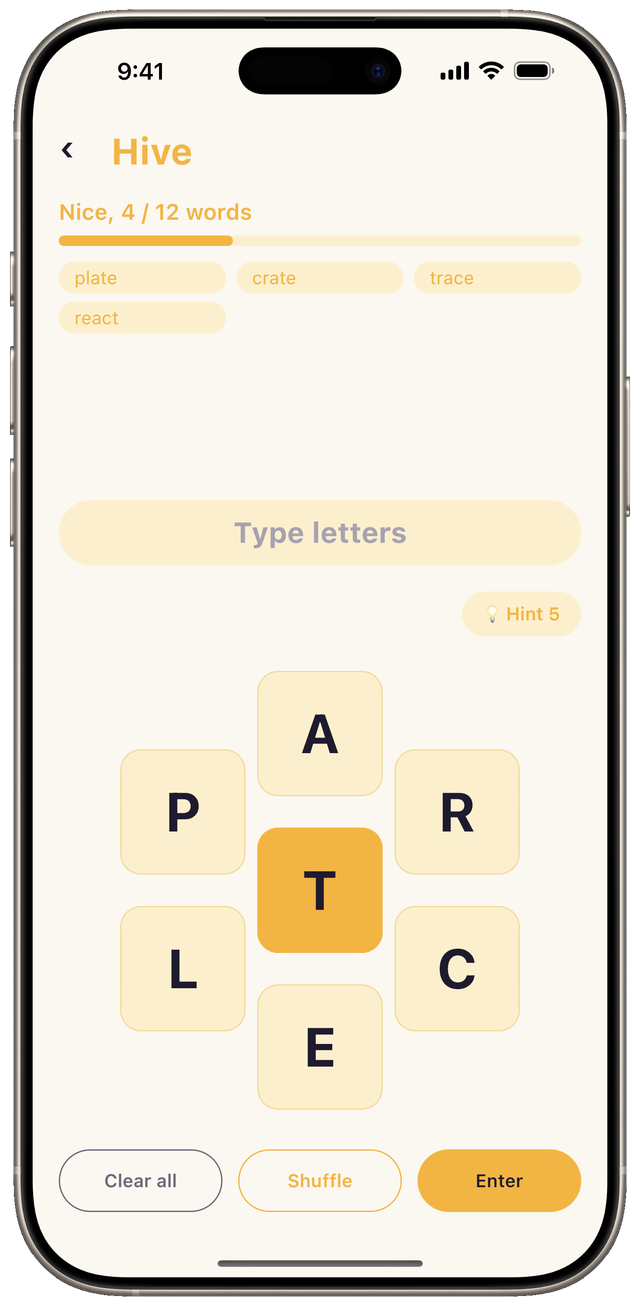
In the Hive tutorial the centre letter is A and the outer letters are T, R, S, E, N and L. RENTS passes the first two checks and fails the third, so the message is about the centre letter. The list is never consulted.
Chain Letters checks, in this order:
- At least three letters.
- Only letters from the box.
- No two letters in a row from the same side — “Two letters from the same side.”
- Starts with the last letter of the previous word.
- On the list — “Not in word list.”
- Not used already.
In the Chain Letters tutorial, P and A share a side of the box, so PAD, which is on the list, fails the side rule on its first two letters. The side rule also has a consequence that catches people out: Chain Letters refuses any word with a doubled letter. The two Os in BOOK are two letters in a row from one side, because they are the same letter.
The order gives you a shortcut. “Not in word list.” appears only once a word has passed every rule of the puzzle. If you see any other message, your word may be perfectly good, and it does not fit this puzzle.
Why does dragging across a real word do nothing?
Because in a word search, the words you may find are the words that were hidden. Seek, the word search in Words Attraction, accepts exactly the words it placed on the board. Tracing a real word it did not place does nothing at all.
Its hidden words come from the same dictionary as the other games and run from three to ten letters. The clinical, crude, derogatory and archaic words kept out of the daily answers are kept off Seek boards too. The tutorial says what a miss costs: “Nothing happens. A miss costs nothing here, so hunt as much as you like.” A miss with no penalty is one of the design choices behind a relaxing puzzle game.
Four words a player was sure were real. Only one of them is missing from Words Attraction's English word list. Which one?
Answer: EMOJI, typed into Daily Word — Right. The English list was compiled around 2000, before the word was common. The row shakes and clears, and the guess costs no attempt.
Does the language you play in change which words count?
Yes. Words Attraction plays in English, Russian and Spanish, and each language has its own dictionary with its own limits.
The Russian dictionary is built from nouns in their dictionary form, the nominative singular. Most words that can only be a verb or an adjective are refused, and so are most other forms of a noun: СЛОН is accepted, СЛОНЫ and СЛОНА are not. That is why the Russian Daily Word tutorial bounces ДЕЛАЛ, a past-tense verb. A few words get through anyway: ЗНАТЬ and СТАТЬ are verbs that are also nouns, some adjectives such as ЛЕВЫЙ are on the list, and БРЮКИ, which has no singular, is accepted in the plural. The Russian keyboard has no Ё key, and words with Ё are typed with Е.
Spanish folds accents and ñ onto a 26-letter keyboard. You type CAFE for café and MANANA for mañana, and both are accepted. Seek keeps words spelled with ñ off its boards, so the word search does not show you one written without its ñ. Daily Word’s answers can still be one: ARAÑA has already been the word of the day, typed as ARANA.
How can you tell which check refused your word?
The message, or its absence, tells you. In Words Attraction:
- Daily Word shakes the row. The word is not on the guess list, or the row is not full. Try another word; you have lost nothing.
- Hive or Chain Letters says “Not in word list.” The word passed every rule, and the list lacks it. Newer words and words over ten letters are two known gaps.
- Any other message. The word broke that puzzle’s rule, and the message names which one.
- Seek does nothing. The word is not one of the hidden ones.
- Russian or Spanish refuses a word. Check for a noun in its dictionary form, or drop the accent and the ñ.
None of these means the game thinks your word is fake. Most of them mean the word is real and the puzzle has a rule about it. Winning within those rules is a question of puzzle strategy, not of dictionaries.
Words Attraction has all four of these games in one app: Daily Word, Hive and Chain Letters are new each day, and Seek never runs out. There is no sign-in, and there are no ads unless you ask for one. When you run out of hints, a short video buys another. How that compares with the other ways a puzzle game charges is in what a puzzle game subscription costs. The rest of our puzzle games are on the Games page, and why a software services company builds them at all is on the About page.
Frequently asked questions
- Why won't a word game accept a word I know is real?
- Either the word is missing from the list the game checks against, or it is on the list and breaks one of that puzzle's rules. In Words Attraction's Hive and Chain Letters, a message such as "Must use the center letter." names the rule, and only "Not in word list." means the list itself is the problem.
- Does a refused guess use up one of my attempts?
- Not in Words Attraction's Daily Word. The row shakes, the tiles flash, the letters clear, and you keep every attempt you had. A refused guess is never recorded.
- Can a word be a valid guess but never the answer?
- Yes. Words Attraction checks guesses against a wide list and draws answers from a narrower one, and it keeps clinical, crude, derogatory and archaic words out of the answers only. ANENT and ENEMA are both accepted as guesses in English Daily Word, and neither will be the word of the day.
- Why are newer words like EMOJI not accepted?
- Because the list is older than the word. Words Attraction's English dictionary is a public-domain list compiled around 2000, so EMOJI, BLOG, SELFIE and PODCAST are not in it and are refused wherever you try them.
- Why can't I play a word with a double letter in Chain Letters?
- Because two consecutive letters may not come from the same side of the box, and a doubled letter is the same letter twice in a row. The two Os in BOOK break that rule, so Chain Letters refuses any word with a doubled letter before it checks the list.
- Why does the Russian version refuse verbs?
- Words Attraction's Russian dictionary is built from nouns in their dictionary form, the nominative singular. Most words that can only be a verb or an adjective are refused, which is why the Russian Daily Word tutorial bounces ДЕЛАЛ. A verb that is also a noun, such as ЗНАТЬ, is accepted, and so is a noun that exists only in the plural, such as БРЮКИ.
