Health & Sleep
How to mix sleep sounds that actually mask noise
Match the frequency, not the volume. Sound only masks other sound when the two occupy the same range, so a low rumble from traffic needs a low sound to cover it and voices through a wall need something in the middle, where speech lives. Turning a hissy white noise up does not cover a bass line. It just makes the room tiring. That is why a mix of two or three layers beats any single track at any volume.
This is an audio question rather than a medical one. Whether noise masking is right for you, and what any of it does to sleep quality, is a different subject with better-qualified people writing about it.
Why masking is about frequency
Every sound occupies a band. A television through a wall is mostly low, because the wall absorbs the high end. That is why you hear the bass of a conversation and never the words. Traffic is low too. A dripping tap is high. Voices in the corridor sit in the middle, and they are the hardest of the lot, because the human ear is tuned for exactly that range.
Masking works when your sound is present in the same band at a comparable level. Louder in the wrong band does nothing except add its own noise. This is the whole reason “just use white noise” fails against traffic: white noise is weighted towards the high end, and the rumble comes straight through it.
| What is bothering you | Where it sits | What covers it |
|---|---|---|
| Traffic, a lorry, a distant motorway | Low | Brown noise, heavy rain, a box fan |
| A television or music through a wall | Low to low-mid | Brown noise plus rain |
| Voices in the corridor or next door | Mid | White noise, lighter rain |
| A tap, a clock, small clicks | High | White noise, rain on a hard surface |
| Snoring | Low, with mid peaks | Brown noise as the base, rain on top |
Build the mix in three layers
Layer one — the base. One continuous low sound. Brown noise or a fan. Nothing about it should be interesting. Set it to just cover the rumble, which is usually quieter than you expect.
Layer two — the texture. Rain, or white noise, in the middle of the range. This is what stops speech resolving into words. It also stops the base sounding like a machine, which matters more than it sounds: a perfectly flat tone gets harder to ignore over an hour, not easier.
Layer three — optional, and rare. A third element only if something specific is still getting through. Distant thunder for irregular low sounds, waves if the base feels too static. Skip this layer more often than you use it.
Two things that undo a good mix
Loops with a seam. A repeating clip with an audible join teaches your ear where the loop is, and then your ear waits for it. That is worse than no sound at all. Play any track alone for two minutes before trusting it overnight — if you can hear the repeat, no amount of layering will hide it.
Streaming. Audio pulled from the network re-buffers, drops out, and stops entirely when the connection does. It also means an app doing something at three in the morning that involves the internet. Sounds that ship inside the app do not have any of those failure modes.
Fade, or all night
A fade covers the part of the night when falling asleep is the task, then stops. It leaves the small hours quiet, and it does not train you into needing sound to sleep at all.
All night is the right answer when the noise is all night — a main road, a housemate on a different schedule. The cost is that it becomes part of the room, and going without it later is its own adjustment.
If you are unsure, start with a fade of twenty to forty minutes. It is the easier default to leave.
What we built
Somnia is our version: fifteen seamless loops including brown, white and green noise, rain, thunder, ocean and a box fan, and up to three playing at once with an individual volume slider for each — which is what makes the layering above possible rather than theoretical.
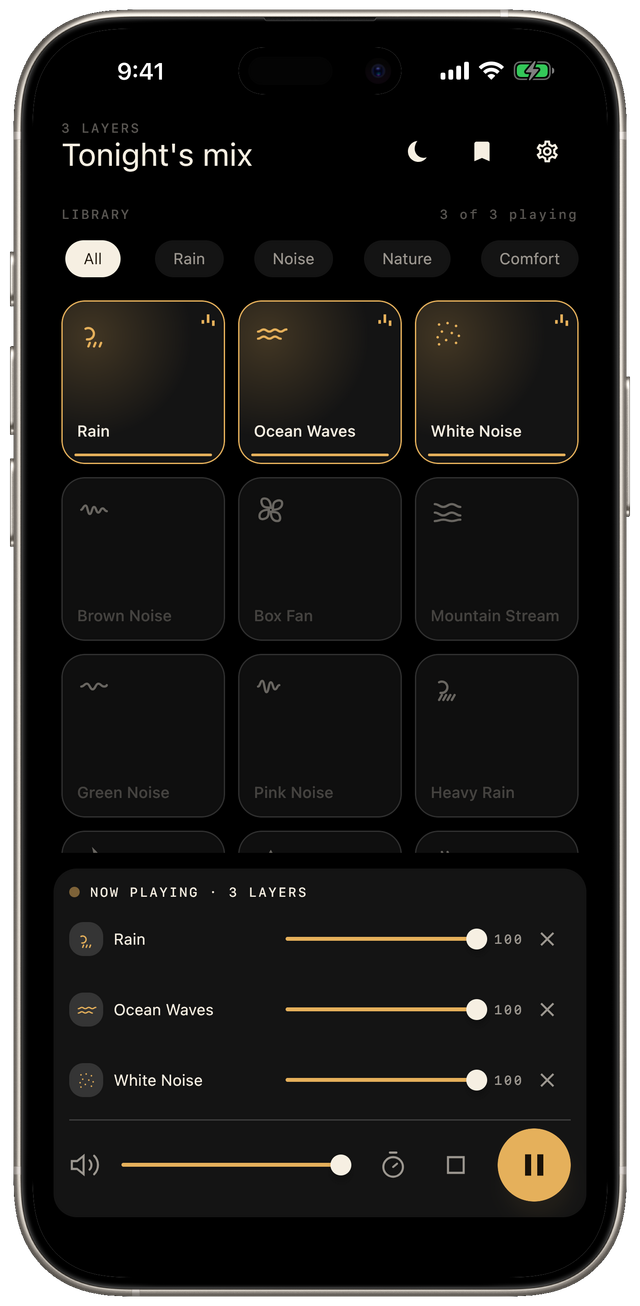
Every loop ships inside the app, so it plays with no connection and cannot re-buffer. The sleep timer fades rather than cutting off. There are no ads, no account, and the full unlock is one payment rather than the $30–40 a year the category has drifted towards — which is the arithmetic in what a puzzle game subscription costs, applied to sounds instead of levels.
If you are wondering what a sleep app knows about you, where your health app data goes covers how to check. The rest of what we make in this category is on the Health & Sleep page, alongside the blood pressure diary.
Frequently asked questions
- Why doesn't turning the volume up block the noise?
- Because masking depends on covering the same frequencies as the noise, not on being louder overall. A hissy sound at high volume leaves a low rumble completely audible while making the room tiring.
- What masks traffic and a neighbour's television?
- Low-frequency sound. Brown noise, heavy rain and a box fan all carry energy low down, which is where the rumble of traffic and the bass of a television live.
- What masks voices and sudden sounds?
- Mid and high frequencies — white noise and lighter rain sit in the same range as speech, which is what makes conversation stop resolving into words.
- How loud should it be?
- Just above the noise you are covering, and no more. If you notice it after five minutes it is too loud, and a mix that sounds slightly too quiet while you are awake is usually right once the room settles.
- Should it run all night or fade out?
- A fade is the safer default: it covers the part of the night when falling asleep is the task, and stops before it becomes something you cannot sleep without. Many people who start with all-night playback end up on a fade.